When commissioning creative work like illustrations or videos, it’s natural to have concerns about copyright. If you plan to make edits in-house—or, as an agency, deliver the work to a client under your own name—it’s important to understand who owns the rights.
In most cases, copyright belongs to the creator. Making changes without permission while the creator still holds the copyright can lead to disputes. However, copyright can be transferred, so this can be addressed by signing a copyright assignment agreement with the creator.
Some creators include copyright transfer in their initial quote, but others don’t. In those cases, you may need to pay an additional fee to obtain the rights. Even if the production cost seems low, it’s important to confirm this at the quotation stage to avoid unexpected charges or misunderstandings later on.
In this article, we’ll walk you through the basics of copyright in creative work, with a focus on key points around copyright transfers and licensing agreements to help you avoid potential issues.
What is copyright?
Copyright law defines the rights of authors regarding literary and artistic works, as well as performances, phonograms, broadcasts, and cable broadcasts, along with related rights. Its purpose is to protect the rights of authors and others while ensuring the fair use of these cultural products, thereby contributing to the development of culture.
Simply put, the main elements of copyright are the “right to use one’s own works” and the “right to prevent unauthorized use of one’s own works.”
Reference:About Copyrighted Works - Agency for Cultural Affairs
What happens when you transfer copyright?
Copyright may be transferred in whole or in part. When copyright is transferred, the transferee gains the exclusive right to use the work in question.
Consequently, even the original author generally cannot use the work after the transfer; if they wish to use it, they must obtain permission from the transferee. Using the work without obtaining permission from the transferee may result in a copyright infringement lawsuit, and the user may be subject to an injunction or a claim for damages.
What is subject to copyright?
The Copyright Act defines a work as a creative expression of ideas or emotions that falls within the realm of literature, academia, fine arts, or music.
In other words, anything that expresses one’s ideas or emotions through words, characters, shapes, colors, music, or art is subject to copyright.
Examples of works under the Copyright Act are as follows:
・Literary works such as novels, scripts, academic papers, lectures, and other linguistic works
・Musical works
・Works of dance or pantomime
・Works of fine art such as paintings, prints, sculptures, and other visual art
・Architectural works
・Maps, or drawings, charts, models, and other graphic works of an academic nature
・Cinematographic works
・Photographic works
・Computer program works
What is not subject to copyright?
Next, we will list items that are not subject to copyright.
Works that are not protected under the Copyright Act are as follows:
(i) The Constitution and other laws and regulations
(ii) Notices, directives, circulars, and other similar documents issued by organs of the national or local governments, independent administrative agencies, or local independent administrative agencies
(3) Court judgments, rulings, orders, and adjudications, as well as administrative agency rulings and decisions made through procedures equivalent to court judgments
(4) Translations and compilations of the items listed in the preceding three items, created by organs of the national or local government, independent administrative agencies, or local independent administrative agencies
About Articles 27 and 28 of the Copyright Act
In a contract for the transfer of copyright, if the rights specified in Article 27 (right of adaptation) or Article 28 (rights of the original copyright holder regarding the use of derivative works) are not specifically listed as the subject of the transfer, it is presumed that these rights have been reserved by the transferor.
In other words, if the contract does not explicitly state that the rights specified in Articles 27 and 28 of the Copyright Act are included, it is presumed that they are “not subject to transfer.”
The right of adaptation (Article 27) refers to the right to make changes to a work, such as through translation, dramatization, or film adaptation.
The rights of the original copyright holder (Article 28) refer to the rights of the original author to utilize “derivative works.”
For example, suppose a contract is signed to transfer the rights to a “novel,” but the transfer of the right of adaptation (Article 27) is not explicitly stated. In that case, the transferee may be unable to adapt the work into a film. Even if the film adaptation is realized, since the rights of the original copyright holder (Article 28) have not been transferred, the author of the novel would still hold copyright in the “film,” which is a derivative work.
How can you prevent disputes when transferring copyright?
Signing a copyright transfer agreement
To avoid disputes when transferring copyrights, be sure to sign a copyright assignment agreement.
Since the terms agreed upon by both parties are documented in writing, this helps prevent disputes arising from misunderstandings.
While you can find sample copyright assignment agreements online, consulting with a lawyer is likely to be more effective in preventing potential issues before they arise.
Reference:Proper Use of Copyrighted Works - Agency for Cultural Affairs
What does “not exercising moral rights” mean?
A common issue regarding the terms of copyright assignment agreements is the clause stating, “Author A shall not exercise moral rights regarding Work A against B.”
This is known as a “non-exercise clause” for moral rights, whereby Author A promises B that they will not exercise their moral rights regarding the work.
Since moral rights are non-transferable, the wording uses the phrase “shall not exercise.”
Without this provision, the transferee may face inconveniences, such as being unable to modify or alter the transferred work.
Conversely, for creators and designers, this provision serves as a right to prevent unauthorized modifications or alterations to the work in question.
By specifying in detail within the copyright assignment agreement whether the author’s approval is required for modifications or alterations to the work, and how such approval is to be obtained, it is possible to prevent disputes.
The difference between a license agreement and a copyright assignment agreement
A license agreement is an arrangement under which a licensee pays a license fee for a company’s proprietary know-how—such as patented technologies, utility models, designs, copyrights, and trademarks—and manufactures or produces the relevant products at the licensee’s own risk.
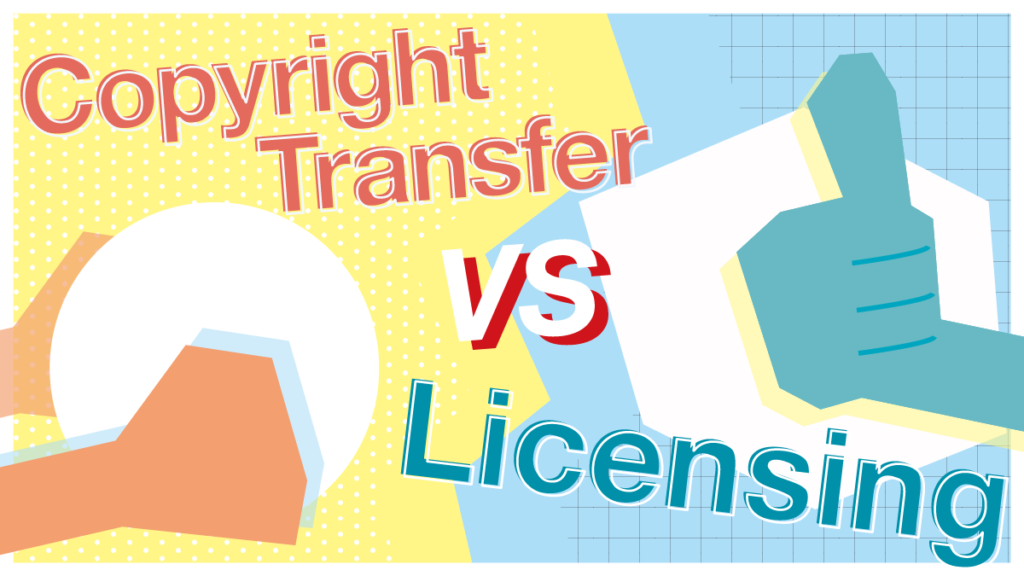
The key difference is that while entering into a copyright assignment agreement prevents the author from using the work, a license agreement allows the author to continue using the work.
Points to note in license agreements
Exclusive vs. non-exclusive licenses
If the agreement stipulates that the licensor may use the licensed rights exclusively and may not grant licenses to anyone other than the licensee, granting a license to a third party would constitute a breach of contract, as it would violate those terms.
When entering into a license agreement, be sure to specify in detail whether the license is exclusive or non-exclusive.
Limitations on territory, term, and scope of use
When entering into a license agreement, it is essential to clearly define the licensed territory, term, and scope of use.
Be sure to clearly stipulate the scope of use, the types of intellectual property covered, the types of rights granted, the temporal, territorial, and substantive scope of the license, as well as whether sublicensing, subcontracting, or manufacturing outsourcing is permitted, and how improvements or inventions are to be handled.
Sublicensing
A sublicense agreement is a contract whereby a licensee, having obtained permission to use a work from the rights holder, grants that permission to a third party. Companies often acquire sublicensing rights when they wish to have affiliated companies or other entities engage in licensing activities.
From the rights holder’s perspective, it is difficult to monitor the actions of third parties, which can pose significant risks. Be sure to thoroughly review the terms of the agreement.
Reference: Documentation of Copyright Assignment Agreements - Ministry of Education, Culture, Sports, Science and Technology
About joint works
A joint work is defined as a work created jointly by two or more persons, where the contributions of each individual cannot be separated and used independently.
As a result, all of the joint authors are considered the authors of the joint work.
In other words, both the moral rights and copyright in a joint work belong to all of the joint authors.
Therefore, the permission of all joint authors is required when using a joint work.
Summary of copyright assignment
In this article, we have explained the key points to consider regarding the transfer of copyright.
To prevent disputes, be sure to sign a copyright assignment agreement when transferring copyright.
When drafting a copyright assignment agreement, be sure to take Articles 27 and 28 of the Copyright Act into account. By clearly specifying how moral rights are to be handled in detail, you can significantly reduce the likelihood of future disputes.
Additionally, instead of assigning copyright, you may also consider a licensing agreement.
Please review your options to determine which type of agreement is best suited to protect your work.
Marketing Perspective in Japan: Beyond Just Creation
NOKID provides creative planning and production for PR using characters, events, and video content. Effective videos balance business and creative perspectives, e.g., short clips optimized for TikTok, designed to capture attention in the first 2–3 seconds.
For first-time animation or PR-focused content, feel free to consult with us.