Many people may know that Pokémon holds the world record in IP revenue. Seeing this, some companies might consider focusing on characters (IP) and want to utilize it themselves. However, it's not uncommon for many companies to mistakenly believe that “if we create a popular character, it will naturally sell.”
In reality, characters painstakingly created often fade away within a few years. They fail to gain recognition, merchandise doesn't sell, they aren't accepted overseas... This cycle leaves many responsible staff exhausted.
Whether you're considering IP development or already own a popular IP, you'll likely contemplate overseas expansion. But how should you approach it?
You might think Pokémon's case is too massive to be relevant, but it wasn't this large-scale from the start, offering plenty of actionable insights.
Pokémon began its expansion centered around games, but it gained and maintained popularity through a “media mix strategy” where anime, merchandise, and other elements synergized. Specifically, in the US, they aired the anime before the games, building character appeal before releasing the games – carefully considering each medium's role in the strategy.
This time, we'll unravel the media mix expansion that propelled Pokémon's IP revenue to the top globally.
Many characters and games venture overseas, but most fade from the spotlight within a few years. Amidst this, Pokémon has been loved worldwide for over 25 years.
Many characters are created with “child-friendly cuteness” or “eye-catching designs.” However, Pokémon incorporated something more fundamental into its design: the human psychology of becoming engrossed.
The prime examples are “collecting,” “raising,” “trading,” and “battling.” These are actions people find enjoyable regardless of age or nationality.
While collecting alone might be a temporary pursuit, activities like raising Pokémon or battling—which foster interaction with others—possess enduring appeal.
For example, parents and children collecting cards together, or friends battling each other, are activities that occur naturally in any country.
In reality, people belong to some kind of community, be it a country or an organization, and emotions like superiority or inferiority constantly arise through interaction with others.
In other words, Pokémon possessed a design that felt “fun” across cultures.
Many people might think Disney is the world's highest-earning character IP. While Disney may indeed lead in “brand recognition,” Pokémon takes the crown in terms of revenue.
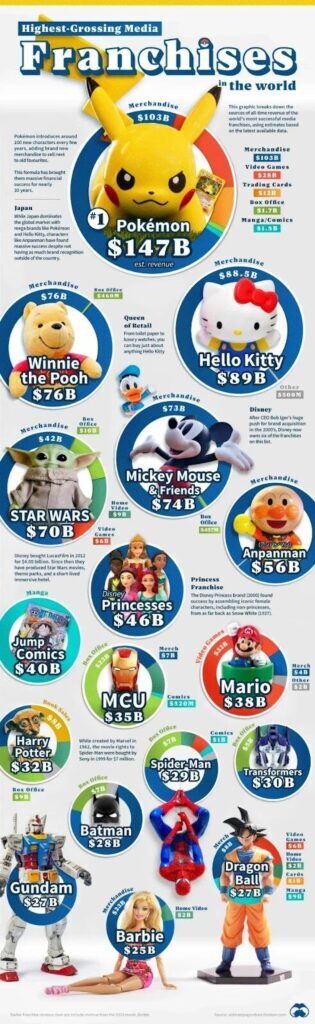
According to VISUAL CAPITALIST, Pokémon's cumulative IP revenue as of 2024 is estimated at $147 billion, surpassing Disney and Hello Kitty. This revenue is spread across multiple sources: games, anime, cards, merchandise, and events. While Pokémon merchandise accounts for over half of this revenue, one shouldn't assume that simply expanding into goods is a surefire way to profit.
Specifically, in Japan, Pokémon first launched as a game, gained popularity, and then expanded into anime and merchandise. It's precisely because fans already knew the characters and world well that the merchandise sold well.
In other words, building relationships with fans across multiple media platforms is what led to Pokémon becoming the top-earning IP.
Revenue and reception outside of Japan
Pokémon became the world's top-grossing IP not only due to its success in Japan but also because of its achievements in overseas markets.
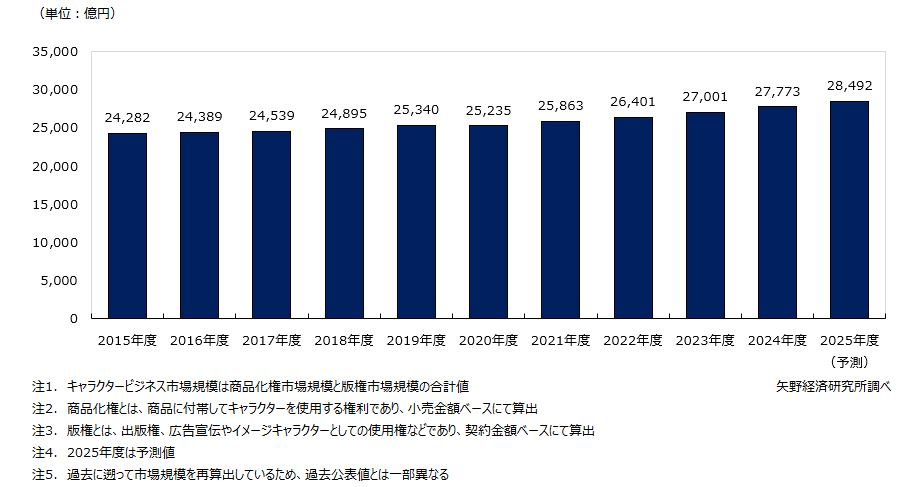
According to Yano Research Institute, the domestic character business market size in Japan is estimated to be ¥2.7773 trillion (approximately $20 billion) in 2024. Meanwhile, a study by Licensing International indicates that the global licensing market reached $369.6 billion as of 2024.
If Pokémon had been a character popular only in Japan, it would have been impossible to generate the world's highest revenue given this scale difference. In fact, the majority of Pokémon's revenue comes from overseas sales of games, cards, anime, and merchandise.
In other words, Pokémon achieved the world's highest revenue not just because of its popularity in Japan, but because it was embraced worldwide.
Pokémon's #1 IP revenue success overseas- More than a miracle
Many people tend to think Pokémon's success was “just a fluke” or “simply carried over its Japanese popularity overseas.” However, the reality is that behind this success lies meticulous strategic planning.
Specifically, Pokémon changed its “rollout sequence” and “media usage” for each market. Rather than simply exporting products, they worked backwards from “how local people would enjoy it” to determine their approach.
Recognition in the US through anime first
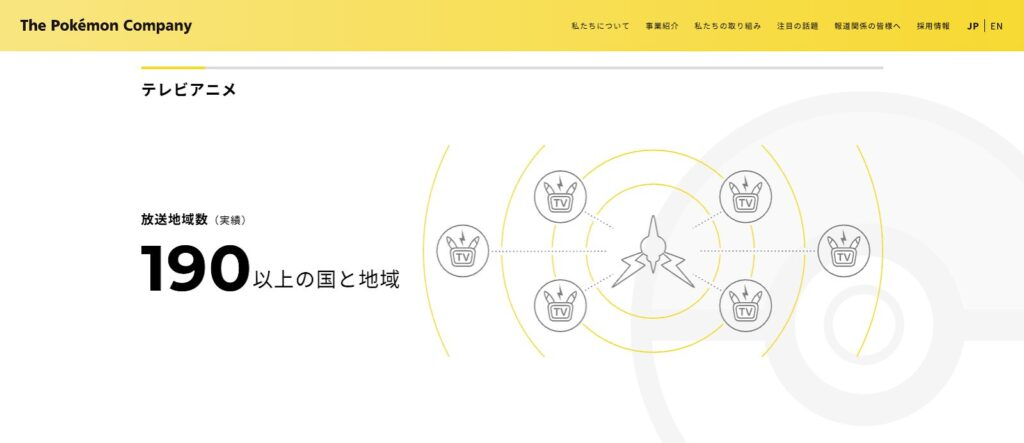
The conventional wisdom is that to sell a new game, you first release the game itself to generate buzz. However, Pokémon reversed this approach for its U.S. launch. They first aired the anime, allowing fans to connect emotionally with the characters and story, and only then released the games and cards.
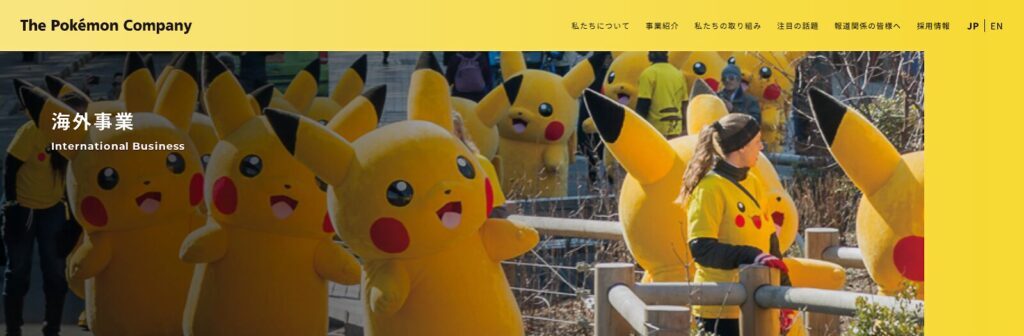
Official documentation also details this overseas strategy, so I'll quote it here.
“In the U.S., we devised a strategy to roll out content in a different order than in Japan. While Japan launched with the video game, followed by the card game, and then the TV anime, the U.S. chose to air the TV anime first.”
This sequential rollout allowed the game to be accepted not as a “product to buy,” but as a “tool to further enjoy a world they already loved.”
For example, children who watched the anime featuring Pikachu naturally wanted to befriend Pikachu in the game, leading to purchases.
In other words, by investing upfront in fostering emotional connection to the characters, they accelerated purchasing behavior.
Creating awareness opportunities, employing storytelling that stimulates emotion, and generating revenue—this IP expansion flow also applies to IPs like “ChiiKawa” and “Sanrio Characters.”
One reason overseas expansion often fails is localization that stops at mere translation. Pokémon overcame cultural barriers by reworking its content into forms that resonate with local cultures and sensibilities.
Many companies literally translate product and character names when expanding overseas. However, Pokémon created new names suited to the local linguistic sensibilities and culture, rather than relying on direct translations.
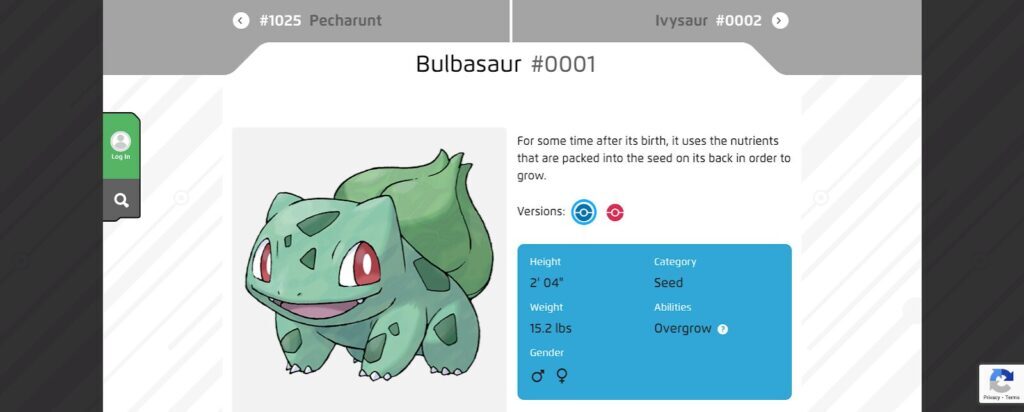
For example, “Fushigidane” became Bulbasaur (bulb + dinosaur) in English. This form is easier for local children to visualize. It's also well-known that ‘Satoshi’ was renamed “Ash” in the English version to make it more approachable.
These adjustments tailored to the local audience make the characters easier to accept. The affection shown by children overseas proves that the ingenuity in naming is a success in cultural adaptation.
Indeed, Professor Ken Fujii, Dean of the Faculty of Business Administration at Hakko University, stated the following in an interview:
“By optimizing the approach for each region, the originality remains intact while gaining acceptance in overseas markets.”
In other words, even something as simple as a name requires strategic design to take root locally.
Creating “Pokémon for local markets” with regional partners
Many companies outsource their overseas expansion entirely to local agencies, but this often leads to a dilution of brand consistency and appeal. Amidst this common approach, Pokémon adopted a stance of “co-creation” with local partners.
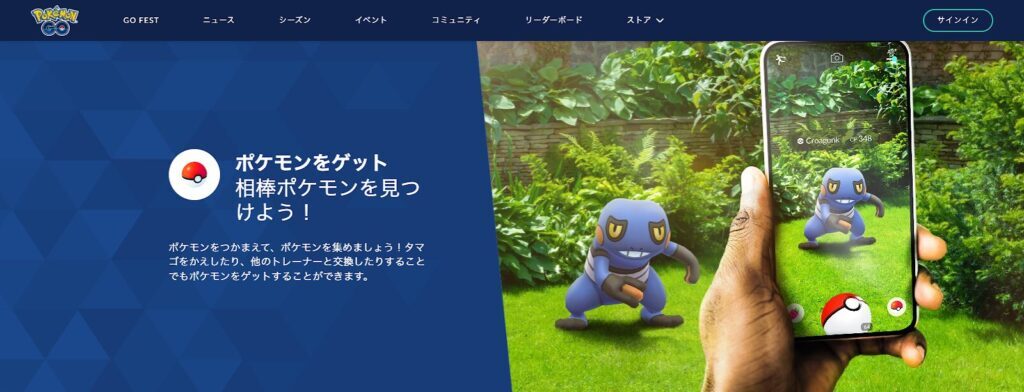
For example, with Pokémon GO, they partnered with Niantic to engage local users through a new format: location-based gaming.
This co-creation is essential for implementing strategies tailored to local markets while preserving the essence of Pokémon.
In other words, local partners are not outsourced vendors, but “co-creators” who help nurture the brand.
Analyzing Pokémon’s media mix strategy as the top IP earner
Did the Pokémon anime become the “gateway to the IP” and drive popularity?
The anime serves as a means to make the world aware of Pokémon's existence.
It's often thought that “the anime focuses primarily on ratings and advertising revenue,” considering the profit of the individual work.
However, for the Pokémon anime, its primary role is prioritized as “an opportunity for people worldwide to learn about Pokémon,” with a strong focus on developing the entire IP rather than just the individual work.
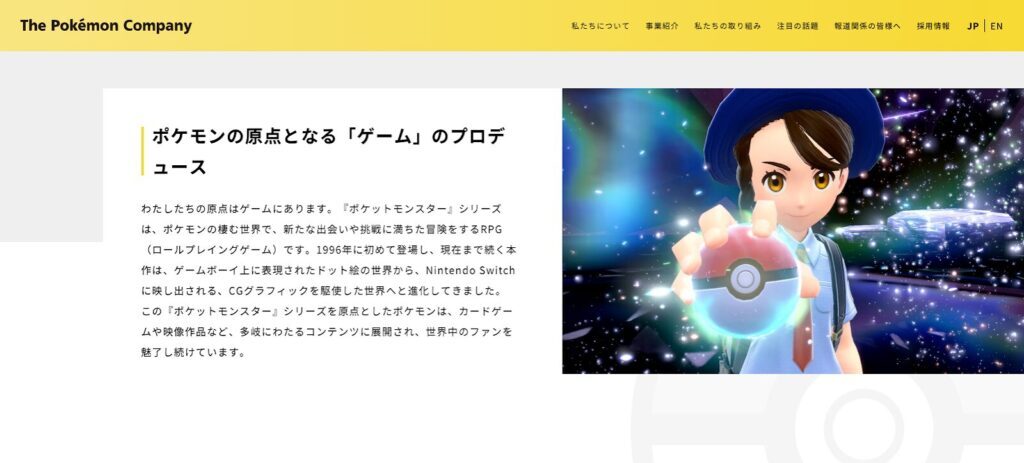
In fact, the official statement reads as follows:
The TV anime “Pokémon,” which has been airing since 1997, serves as the first opportunity for children to encounter Pokémon.
The anime's global acceptance wasn't merely due to its wide broadcast reach. The biggest factor was likely the introduction of an “iconic character.”
Pokémon has centered its marketing around “Pikachu” as its iconic character. Today, Pikachu appears in games, anime, merchandise, and events, becoming the face of the brand.
Particularly in the US, as mentioned earlier, they adopted a strategy of airing the anime before the games. This created a flow where children first became familiar with the characters, followed by sales of games and cards.
In this way, Pokémon creates the optimal entry point (point of contact) for each country and promotes accordingly.
In other words, the Pokémon anime serves the role of drawing viewers into the brand's worldview by having its “symbolic character” evoke empathy or affection through the series.
Localization can be seen as a means to facilitate this process smoothly.
The role of drawing viewers into the IP's world
As mentioned, the Pokémon anime doesn't just generate profits on its own. It's strongly tied to other media expansions like games and merchandise.
It creates a flow where characters discovered in the anime can be “made your own” through games, and then “brought back into daily life” via merchandise.
Furthermore, on social media, clips from the anime flood feeds, and their secondary dissemination also serves as material to attract new fans.
In other words, the anime also holds the “important role of conveying the story” that elevates the entire IP.
Game software supports the brand as the “core experience”
Maintaining unwavering popularity even as the series continues
While it's commonly believed that “popularity and sales decline as a series continues for a long time,” Pokémon maintains such strong competitiveness that the sales performance of its latest titles even surpasses that of the original.
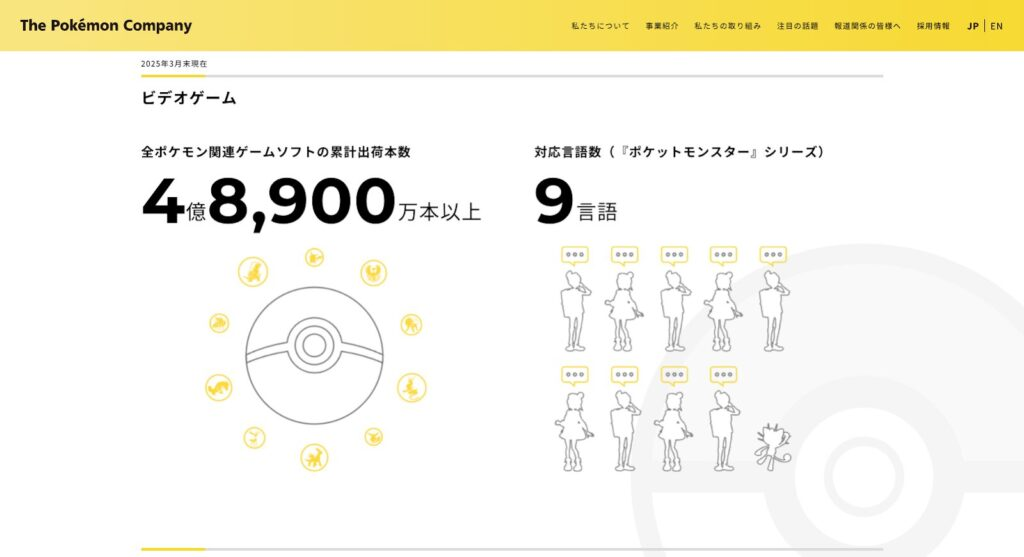
In fact, official Pokémon information states that cumulative shipments, including related software, exceed 489 million units (as of the end of March 2025).
In other words, even as the series tends to shrink with each new installment, Pokémon games continue to break records. This can be seen as a result of the media mix strategy continually attracting new audiences.
Strategies that encourage users to promote the game organically and boost sales
The reason Pokémon games have endured for so long isn't simply because they're fun. The biggest factor is likely the way they built “social elements” into their core mechanics.
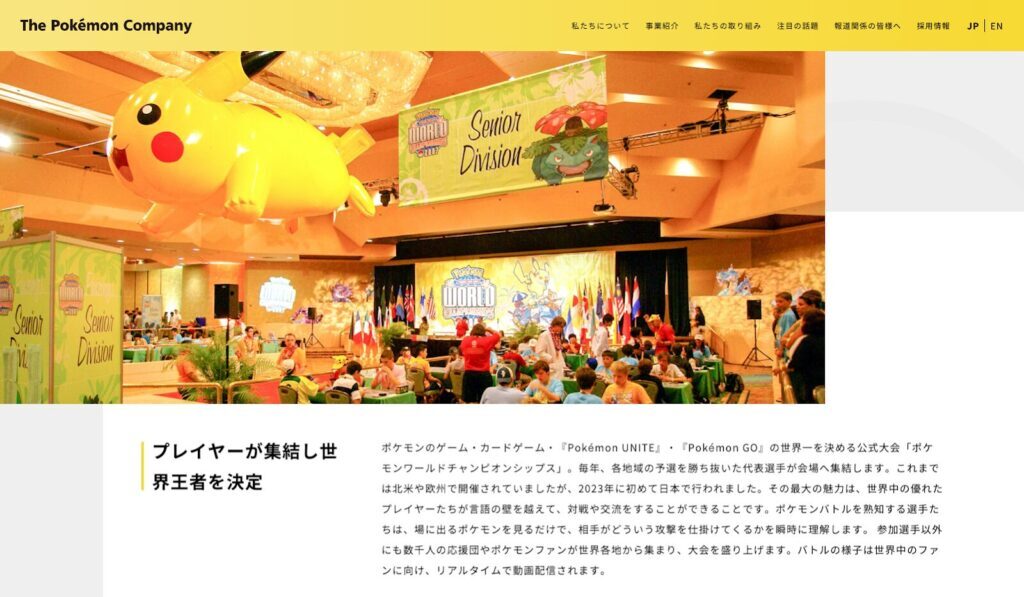
While most games focus on selling a single title, the original Pokémon released two versions—‘Red’ and “Green”—simultaneously and made trading between players essential. This system naturally fostered word-of-mouth promotion and encouraged friends to buy the game.
As a result, Pokémon evolved from a game you could clear solo and then lose interest in, into something that spread like “a daily habit enjoyed together.” Furthermore, the strategy of remakes and remasters has a dual effect: it brings back past fans while also opening up new demographics.
This mirrors the structure of social media diffusion. Users actively promote the game to gather playmates, leading to an overflow of positive word-of-mouth.
In other words, Pokémon's promotion isn't a one-time sale; it's designed as a “system that sells across generations.”
Games are the core tool for experiencing the world
The role of games in Pokémon is to serve as the IP's “core,” influencing other media.
While the order of release varies by country, the cycle where characters introduced in games appear in anime, and characters discovered through anime are collected via merchandise, allows fans to engage with Pokémon through “watching, playing, and owning.”
Furthermore, every time a new title is released, it sparks excitement for cards and events, revitalizing the entire IP.
Looking at past trends, it's not uncommon for a new anime series to launch alongside a game release, with related merchandise rolling out simultaneously.
In other words, the games aren't standalone content; they serve as the “engine” driving the entire ecosystem.
Source: 'Pokémon GO's “Evolving Story” — New Season Begins! - YouTube
Why didn't it just become a passing fad?
Many smartphone game apps tend to see their popularity decline within a few years. However, “Pokémon GO” continues to generate high revenue even years after its release.
Pokémon GO debuted as a new app, but it connects to the “stories and characters” of the Pokémon anime and game series. This likely allowed it to be accepted not as something separate from Pokémon, but as an evolution of the franchise.
The biggest reason for Pokémon GO's success might be that it transformed everyday life into play. It integrated walking, traveling, and meeting friends into the game itself.
As a result, people gathered in parks and tourist spots, creating a social phenomenon where they searched for Pokémon in the real world.
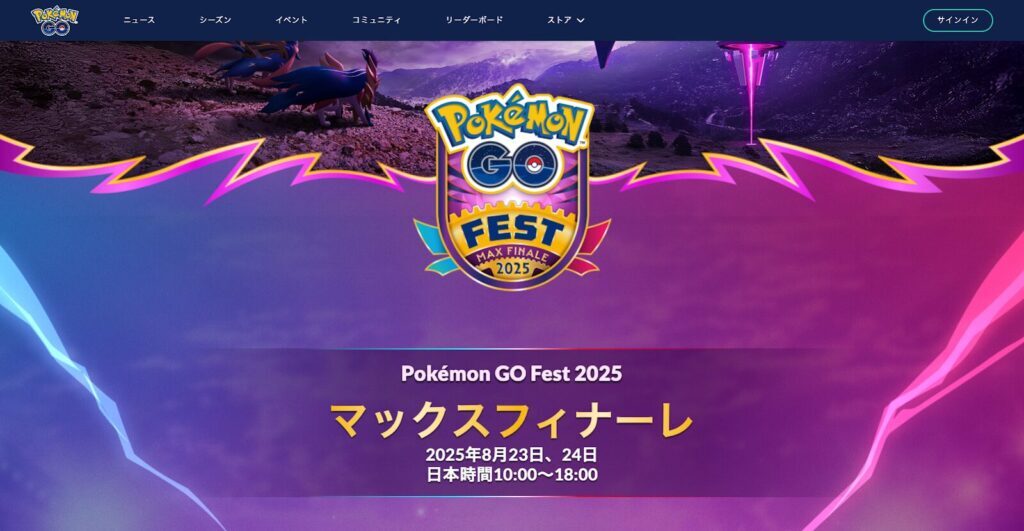
Furthermore, while main titles often receive all the promotional attention, leaving spin-off services feeling like mere “extras,” Pokémon GO has continued to hold regular events since its release.
These real-world events draw tens of thousands of participants, creating opportunities to deepen bonds through the game. This likely contributes to the game's ability to keep players engaged and enjoying it long-term without losing interest.
In other words, it didn't just release an innovative game and stop there; it established a “sustainable revenue model.”
A groundbreaking promotion that turned entire cities into advertising media
While ordinary games attract players through ads and campaigns, Pokémon GO transformed real-world cities themselves into “advertising media.”
By combining AR and location data, its game system provides new experiences as players walk around. This enabled regional events to be held, linking with tourism and restaurants to expand brand exposure.
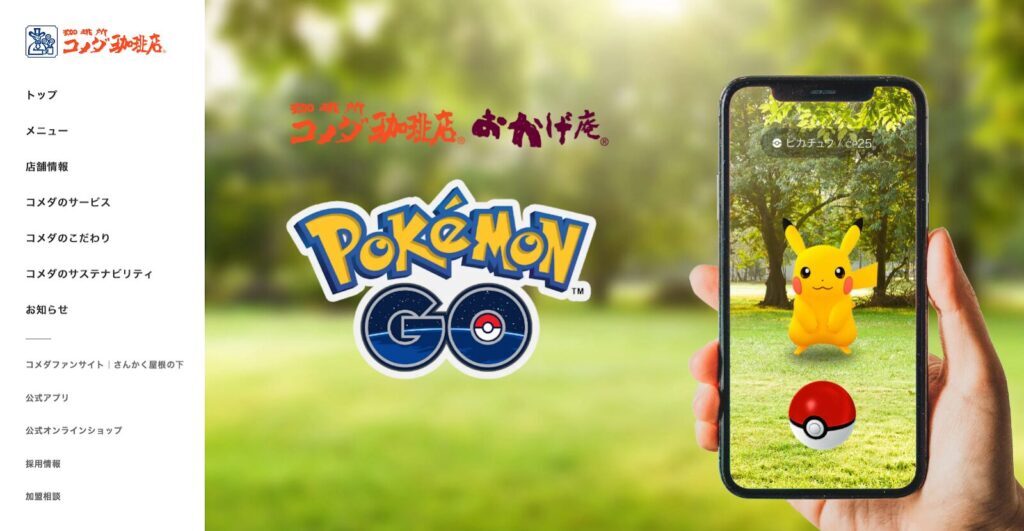
For example, initiatives like partnering with Komeda Coffee Shop orAEON MALL to turn stores into “PokéStops” can be seen as a promotional method that not only attracts customers but also enhances the enjoyment of the game.
From an advertising perspective, it can be considered a form of experiential advertising, meaning it should be highly effective without causing discomfort.
In other words, Pokémon GO isn't just a conventional customer attraction method; it involves the entire town in the promotion.
Summary of the media mix strategy that made Pokémon the world’s top IP earner
Let's summarize the key points so far.
The combination of “collecting, raising, trading, and battling”—elements that easily captivate people—ensures the game continues to be played across countries and age groups.
The anime functions less as a standalone revenue generator and more as a gateway, expanding character recognition worldwide.
The strategy of featuring Pikachu prominently unifies visual impressions and enhances memorability.
In the US, “optimizing the sequence” by releasing the anime first creates a flow: emotional connection → game purchase.
Localization goes beyond mere translation—through name changes and more—ensuring intuitive appeal for local children.
Games remain the core experience; releasing new titles and remakes keeps the conversation going, sustaining growth even through generational shifts.
The trading and battling mechanics naturally turn friends into promoters, creating a chain reaction of purchases.
Merchandise sells because it offers a “pre-experience” that builds affection, functioning as a major revenue pillar.
Pokémon GO achieved “daily integration” through AR, location services, ongoing events, and city partnerships, transcending a mere fad.
While the Japanese market is large, the global market is orders of magnitude bigger; worldwide popularity has made it the top-earning IP globally.
The essence of Pokémon becoming the world's top IP revenue earner lies not only in its popularity in Japan but in its design that increases “entry points to fall in love” globally and never lets the “reasons to keep playing” fade.
The entry point is anime, the core is games, expansion comes through merchandise and events, revitalization through related games like Pokémon GO and merchandise... This interconnected multi-media approach creates a cycle of awareness → experience → purchase → sharing, continuously growing a borderless fanbase.
Let's consider the role of each service and think about how they can synergize with each other.
Marketing Perspective in Japan: Beyond Just Creation
NOKID provides creative planning and production for PR using characters, events, and video content. Effective videos balance business and creative perspectives, e.g., short clips optimized for TikTok, designed to capture attention in the first 2–3 seconds.
For first-time animation or PR-focused content, feel free to consult with us.
Tokuma Kanna
Founder and CEO of NOKID Inc., a premier creative studio specializing in short-form animation and graphic design. With a focus on narrative-driven visual storytelling, he has spearheaded high-profile projects across the global entertainment landscape. His portfolio includes the acclaimed VALORANT: YORU TYPICAL DAYS cinematic, the Hatsune Miku x Seven Premium 15th Anniversary campaign, and Koda Kumi’s music video "100 no Kotoba-tachi e." As a leading producer in the PV and MV sectors, Tokuma continues to redefine the intersection of animation and contemporary digital media.