When it comes to recruitment for an organization, HR and PR personnel face limitations in delivering messages to each individual job seeker. However, job seekers and potential applicants typically conduct thorough research on companies via social media and search engines before deciding to join.
Effectively utilizing video promotion and marketing in this context creates a recruitment tool that acts as a supplement and sometimes even substitute for HR and PR personnel online, continuously engaging with job seekers and promoting the company.
Beyond recruitment, video is also used to create training content that employees can access for self-directed learning whenever they choose. This reduces the time managers spend on training and prevents inconsistencies in teaching methods that can arise from relying on individual instructors.
Thus, utilizing video significantly contributes not only to online recruitment activities but to overall organizational development. However, creating live-action videos raises concerns like the “effort required for filming” and “copyright risks” if featured employees leave the company.
Animated videos for recruitment offer a flexible solution without these concerns. Furthermore, combining animation with live-action footage creates videos that blend realism and expressive power, leveraging the benefits of both approaches.
This article will explain in detail why animated videos are effective and their advantages in recruitment activities
How to attract top talent (new graduates and mid-career hires) with recruitment animation videos
The success of recruitment animation videos requires going through the following process. Even if you've worked hard to create your own message, it's meaningless if it isn't received.
To attract top candidates like new graduates and mid-career job seekers during recruitment, it's essential to create opportunities for many people to learn about and become interested in your company. Publishing videos on different platforms is a key method for achieving this, as it allows anyone to learn about your organization per their own convenience.
Specifically, the following elements are necessary:
Creating touchpoints with job seekers through online content
Utilizing these touchpoints to spark interest in your company
We will explain each of these points below.
Creating touchpoints with job seekers through online content
At the outset, we mentioned that videos are an effective recruitment tool for conveying your company's appeal to job seekers. There are limits to how many applicants a single HR or PR representative can reach. To overcome this, utilizing videos and website articles as online content can be very effective.
Online content acts as a window, creating touchpoints with job seekers on behalf of HR and PR personnel and continuously conveying messages.
Furthermore, online, “applicants interact with content, not directly with people.” This means that for job seekers searching for information online via social media and other channels, the existence of content published by companies becomes the most critical factor.
Leveraging touchpoints to spark interest in your company (building a talent pool)
To successfully advance recruitment, it is first necessary to make people aware of your company's existence. Then, from among those who become aware, you need to get more job seekers to feel a connection and interest.
Only then does the process finally move to the stage of presenting employment conditions—a competition based on qualifications—which leads to applications. That is precisely why getting more people to feel a connection and interest is the key to successfully advancing recruitment.
For example, finding an outstanding candidate among 100 people is far more likely than finding one among just 5. Therefore, to increase the number of applicants, you need to publish online content that attracts many job seekers and encourages them to consider applying.
Understanding changes in job trajectory for applicants
Traditionally, recruitment activities have involved posting job advertisements, communicating with applicants via email and phone, and conducting in-person interviews. However, the way we interact with and engage job seekers has changed, now requiring information sharing on platforms like YouTube, Twitter, and TikTok, as well as simple communication via LINE.
Q2. When communicating with companies during job hunting, what tool would you most like to use? (Student responses)
According to Neo Career's “2022 Survey on Communication Tools Used During Job Hunting,” LINE ranked first in 2022 as the tool students most want to use for communicating with companies during recruitment. Its usage rate increased from 17.1% in the 2018 survey to 54.0% in 2022.
Meanwhile, email ranked first among tools companies use to communicate with students during recruitment, indicating a gap exists.
Q4. In your recruitment activities, what communication tool do you use most frequently with students? (Company responses)
Companies must be flexible because job seekers' behaviors and mindsets change daily.
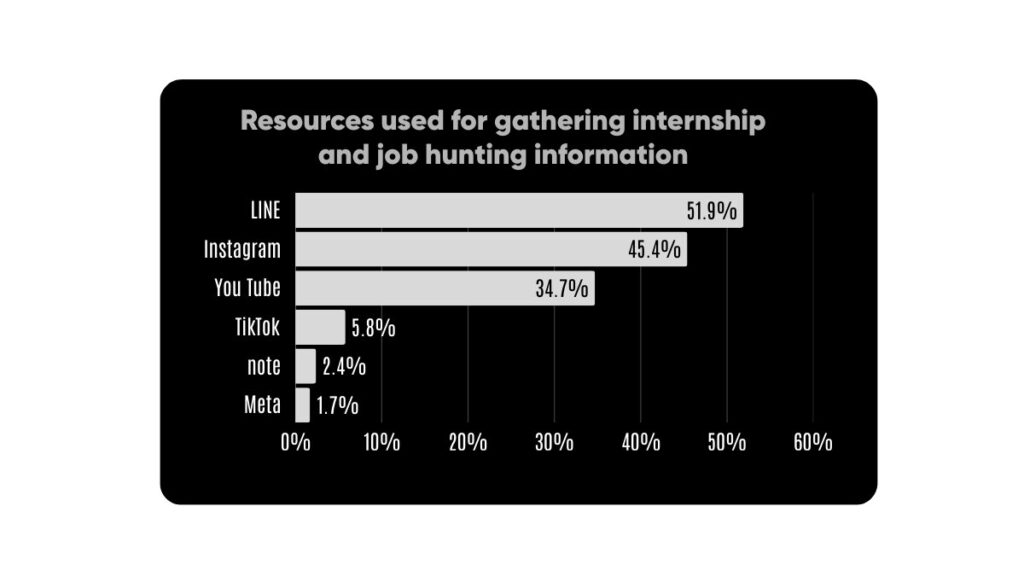
According to the “Mynavi 2023 Graduate University Student Internship and Job Hunting Preparation Survey (October),” 62.7% of students gather internship and job hunting information via social media. In the modern age, it has become commonplace to look at a company's social media accounts and research the company itself.
You can understand that having no information about your company available online is a significant disadvantage, and for potential applicants, a major red flag or even a dealbreaker. That is precisely why it is essential to use video to communicate with these job seekers.
How to encourage job seekers to join
After gathering job seekers using the methods mentioned earlier, it's crucial to also consider the emotional aspect of the appeal of your company during the job offer consideration phase.
To achieve this, the key point is that the company's purpose must be compelling to job seekers.
The pitfalls of focusing solely on “compensation competition”
The hiring challenge faced by many companies actually stems from a major mistake: it has become a battle of specifications.
This battle of specifications means companies are competing based on conditions like benefits, salary, and reputation—the “specs”—rather than their fundamental reason for existing.
Why is this a mistake? To understand the answer, let's examine the current job market.
The lifetime employment system is now effectively collapsed. At a Japan Automobile Manufacturers Association chairman's press conference on October 13, 2019, Toyota Motor Corporation President Akio Toyoda stated, “Unless incentives emerge for companies that continue employment, it will become increasingly difficult to maintain lifetime workers,” sparking significant discussion.
According to a survey on SDGs conducted by the job-hunting site “Asagaku Navi 2023” targeting university and graduate students scheduled to graduate in March 2023, 70% of students responded that their interest in applying to a company increases when they learn the company has SDGs initiatives.
In this way, resonating with a company's values—such as its social contribution—leads to a desire to work there. Work-style reforms have also influenced this shift, meaning a company is no longer merely a place to earn income. This is because the internet and social media have ushered in an era where it's easier to earn income without belonging to a company.
Therefore, companies must communicate to job seekers the “meaning of belonging to the company”—such as its social contribution—which serves as the reason to join or change jobs.
If job seekers don't perceive meaning in belonging to a company or don't see commensurate benefits, they are highly unlikely to apply, weighing the freedom of earning independently against the potential offer.
Stimulating your appeal as a workplace
Making people feel the meaning of belonging to a company—the reason for joining or changing jobs, is tied to resonating with the company's mission. However, simply communicating the mission isn't enough.
What matters is whether job seekers feel, “I want to join that company,” as mentioned earlier regarding “social contribution.” This can be thought of similarly to how people form impressions.
Are you familiar with Mehrabian's Law? It suggests that in human communication, the influence is distributed as follows: “visual information 55%,” “auditory information 38%,” and “content of speech 7%.” For example, if someone looks angry (visual information), even if they say “I'm happy” (content of speech), people tend to perceive them as angry.
You can also find an explanation of Mehrabian's Law in the following video.
Source: 【First Impressions Are Everything】What Is Mehrabian's Law That Determines First Impressions? 【Business-Themed Short Anime】 【Shark and Turtle】
Conversely, when all three elements align, the message resonates even more deeply with the recipient. In other words, when a company has a clear mission defining its purpose, and its actions and statements are consistent with that mission, its values truly connect with job seekers.
This is precisely why relying solely on “conditions” like salary and benefits to attract candidates leads to mismatches and lack of applications. Such an approach confines decisions to purely rational, logical judgments.
Thus, fostering a genuine desire in candidates to join is crucial. To stimulate this emotion, carefully considering the “expression” used to convey your message to candidates is vital. However, this means nothing if what you communicate hasn't been thoroughly developed.
Using animated videos as part of a recruitment strategy
Incorporating animated videos into recruitment strategies enables companies to clearly showcase their brand and values, capturing the interest of job seekers across both mid-career and new graduate hiring.
Furthermore, it helps streamline the new graduate and mid-career hiring processes, strengthening the company's talent acquisition strategy. Below, we explain the specific value of using animated videos in recruitment activities.
Consistently deliver clear explanations at a high level
Particularly in mid-career hiring, where job changes are fundamental, it's crucial for candidates to quickly understand the company and feel the appeal of the position. In this context, animated videos are well-suited for conveying abstract concepts like “What kind of talent are we seeking?”
Conversely, in new graduate hiring, candidates often struggle to form concrete images of job duties or company culture. Here, animated videos and characters play a role in creating a sense of familiarity and making it easier for candidates to visualize the role.
For example, one company created an animation video specifically for mid-career hires, weaving in scenes of daily workplace life, project activities, and team member testimonials. This approach led to improved responses from applicants.
In essence, this creates a situation where candidates can intuitively grasp the career paths offered, the working environment, and the company's atmosphere and philosophy. Combining animation with live-action footage further enhances this effect, conveying a realistic feel while facilitating understanding.
Builds an efficient recruitment process (reducing workload and costs)
Recruitment activities incur not only clear costs like advertising fees, recruitment agency commissions, and brochure production expenses, but also hidden costs such as preparing information sessions and interacting with job seekers.
Utilizing videos can help reduce these labor hours and expenses. For example, using videos to deliver explanations that are repeated at every session enables information sessions that are less dependent on specific individuals.
Furthermore, posting video content creates a semi-permanent state where it continuously appeals to job seekers, leading to savings on advertising costs.
Unifying information sessions previously held at distant venues to online video streaming only also enables savings on travel and transportation expenses.
Enhances the company's image online (increasing touchpoints)
Typically, recruitment activities involve visiting various event venues to directly convey a company's appeal.
However, this approach inevitably leaves some job seekers unreachable. To cover this gap, publishing content that communicates the company's appeal through recruitment animation videos on social media and websites enables spontaneous discovery.
If the content resonates with viewers, it can enhance the company's image among more job seekers than direct visits alone.
Can stimulate the job seeker's desire to “join the company” (compatibility with storytelling)
Animation videos offer flexible expression to move viewers emotionally. They have the power to make audiences empathize with characters and feel moved by the story. This same power can be leveraged in recruitment activities.
To truly move job seekers and inspire them to want to contribute, high salaries, benefits, and business explanations alone are insufficient. Shape your company's story into emotionally compelling animated expressions and appeal to job seekers.
The Effectiveness of Animated Videos in New Graduate Recruitment
New graduates often struggle to form concrete images of job responsibilities and corporate culture. In such cases, animated videos play a crucial role in conveying the meaning of belonging to the company—the reasons for joining or changing jobs—in a more accessible way.
In other words, videos create an environment where candidates can intuitively grasp the career paths offered, the working environment, and the company atmosphere. Furthermore, conveying the company's philosophy and values through storytelling is an effective way to resonate with new graduates.
Thus, animated videos serve not only as a “tool for providing information to job seekers” but also as a “tool for establishing an emotional connection between the company and job seekers.”
Tips and key points for creating recruitment animation videos
Recruitment animation videos are a powerful tool for effectively conveying a company's appeal and resonating with job seekers. When creating one, it is crucial to first clearly define the company's unique characteristics and strengths, then visually express them.
Animation offers a freedom of expression unavailable to live-action footage, allowing abstract concepts and corporate culture to be conveyed through imagery and characters. Furthermore, the video's length and pacing are crucial; it must strike a balance between capturing the viewer's attention and effectively communicating information.
Therefore, we will now explain key points to consider when producing a recruitment animation video, one such means of expression.
Why is it necessary to gain job seekers' empathy?
Recruitment involves numerous steps, such as “attracting applicants,” “screening applicants,” and “negotiating terms.” While it's necessary to create videos tailored to each step, fundamentally, attracting a large pool of applicants (establishing a contactable state) is crucial for securing top talent.
To attract applicants, you must devise ways to reach many job seekers and inspire their empathy and interest.
For instance, companies with innovative technologies or unique corporate cultures can use animation to express these characteristics. Through visual metaphors and symbolism, animation conveys abstract concepts and corporate spirit that real-life footage struggles to capture. By employing diverse elements like color, character design, and movement styles, animation creatively depicts the company's vision for the future and the atmosphere of its work environment.
To achieve this, we'll outline the essential elements needed for videos shared on platforms like social media to spark interest among job seekers.
By employing animation in this way, companies can convey their appeal from multiple angles and on an emotional level, effectively capturing the attention and interest of potential candidates. In recruitment activities, it's crucial to keep in mind that such a visual and emotional approach carries influence beyond mere information sharing.
Storytelling that captures job seekers' hearts
In recruitment animation videos, effective storytelling is a powerful tool that not only conveys information but also appeals to viewers' emotions. By communicating what values the company holds dear and what vision it possesses through a narrative, you can leave a deep impression on job seekers.
For example, stories depicting the founder's struggles or the daily lives of employees can help job seekers feel the company's history and culture.
Additionally, introducing future-oriented, innovative projects in a narrative format emphasizes the company's direction and captures job seekers' interest. The key is for the story to be authentic, relatable, and emotionally engaging for the audience.
Using storytelling allows job seekers to not only receive information but also feel their role as part of the company and the meaning of working there. This builds a deeper level of understanding and connection with the company, going beyond simply providing details about job duties and compensation.
Effective video length and flow
To maximize the effectiveness of recruitment animation videos, the length and rhythm of the video are extremely important. However, since people's concentration spans vary depending on the activity, it is not appropriate to simply state that “the ideal video length is X seconds.”
For recruitment videos specifically, it is essential to determine a length that is neither too long nor too short for the company, ensuring the information is conveyed efficiently and engagingly. While videos around 2-3 minutes are often considered effective for many companies, this is a general guideline; the ideal length actually varies by company.
In other words, the key is to “convey the company's unique characteristics and the ideal candidate profile accurately in the shortest possible time” while simultaneously capturing the viewer's interest.
Regarding the video's rhythm, it's also crucial to skillfully combine varied visuals, music, and narration to capture the viewer's attention.
An effective video should transcend being merely an information delivery tool; it should evoke emotional resonance and interest in the viewer. By carefully crafting visuals and sound, the video can convey the company's message more deeply and on an emotional level.
Three elements for creating recruitment videos (content) that resonate with job seekers
To resonate with job seekers—to create recruitment videos that stir their emotions—these three elements are essential:
Who is the job seeker?
What is the message?
How will it be conveyed?
It's crucial to examine these by separating them into the “core message” and the “method of expression.”
Let's explore each in detail.
What message to convey to which job seekers (content)
First, let's examine the core message. It's crucial to clearly define the following:
What kind of person is the job seeker? = The ideal candidate profile matching the company
What message do you want to convey to job seekers? = Mission, vision, brand story
Tailor messages tied to your mission to align with the ideal candidate profile matching your company. For example, if your mission involves creators changing the world for the better, suitable candidates would be creators themselves or individuals who understand the value of creators.
The message then connects to explaining the creator's current situation and the company's initiatives to elevate their value. If the goal is to enhance creator recognition, this could involve publishing high-quality works publicly or creating and sharing manga/animations featuring each creator as the protagonist.
Communicating these activities as messages to job seekers makes the company more appealing. Creating messages optimized for job seekers requires a marketing perspective. However, this simply involves constructing the brand story from the job seeker's viewpoint. It's better for someone within the company who understands it best to develop this, rather than outsourcing it to an external specialist firm.
We also provide templates you can use for designing the story. Please utilize this template as well.
How to Deliver the Message
Next, consider how to deliver the crafted message to job seekers. This encompasses both the “delivery location”—whether TV, Twitter, YouTube, or digital signage in public spaces—and the expression method, such as articles, videos, or posters.
Distribution Platforms: Where job seekers will see it
In essence, we start with a core message optimized for the target job seekers, then use emotionally resonant delivery methods. We identify where job seekers will actually see it and distribute accordingly. One highly effective method for creating emotionally resonant content is animated video.
But you might be wondering:
“Animation has a unique style, so it's only suitable for certain businesses.”
To address this concern, we'll explain the value animation videos bring to business.
Measuring and improving recruitment animation video effectiveness is essential
To ensure the success of recruitment animation videos, it is essential to regularly measure their effectiveness and make appropriate improvements to the video content. Continuous analysis and refinement are necessary to accurately assess the impact of the videos and build more effective recruitment strategies.
Set measurement metrics necessary for achieving goals
To accurately measure the effectiveness of recruitment animation videos, it is essential to define intermediate metrics related to achieving your goals.
This process requires quantitatively evaluating the actions (responses) taken by job seekers as a result of the video. Specifically, the following metrics can be used:
View count (number of times attention was captured)
Completion rate (probability it met expectations)
Click-through rate (probability interest was generated)
Number of applicants (people considering the opportunity)
Additionally, analyze direct feedback on the video (comments) and reactions on social media.
The key to measuring effectiveness isn't just collecting data, but clearly identifying what improvements or success factors can be derived from that data.
For example, if view counts are high but completion rates are low, the video content might not be meeting expectations. Similarly, if completion rates are high but click-through rates are low, it may indicate that the CTA (Call-to-Action) is unclear.
Based on these results, it's crucial to review the video's message and CTA, refining them to create more effective video content.
Thus, performance measurement is a vital component for advancing recruitment efforts through video. Don't just keep posting and distributing content; ensure you can regularly measure the situation.
Improving and refining video content
To maximize the effectiveness of your recruitment animation videos, continuous content refinement and improvement are essential. The initial version of your video is merely a starting point; over time, it's crucial to keep updating it based on candidate feedback and market changes.
Therefore, regularly review the video's content, messaging, visuals, and other elements to evolve it into something more compelling and effective.
For example, based on feedback from job seekers and data analysis, you might change the storytelling to be more engaging or enhance the visual elements.
It's also important to update the video's message as the company's situation or hiring needs change. By continuously improving and refining your video content in this way, you can sustainably enhance the effectiveness of your recruitment strategy.
The same principles for efficient improvement methods to increase video views apply to managing a YouTube channel.
Character design for recruitment animation videos
Character design in recruitment animation videos is a crucial element for visually conveying a company's brand image. The unique charm and characteristics embodied by the characters reflect the company's culture and values, effectively communicating its distinct identity to job seekers.
Character design and empathy
Character design in recruitment animation videos is critically important for resonating with the target audience and eliciting viewer empathy. Characters symbolize the company's values and culture within the video, playing a role in conveying the company's appeal to viewers. Therefore, characters must align with the interests and values of the target audience and possess traits they can relate to.
For example, when targeting younger job seekers, modern and energetic characters are effective.
Furthermore, it is vital to reflect corporate values such as diversity and inclusivity through the character's backstory and personality. By making the character a relatable and authentic presence, the video leaves a deep impression on viewers, effectively increasing their interest in the company and their motivation to apply.
Thus, character design becomes a crucial means not only for visual appeal but also for embodying the company's philosophy and culture.
The importance of designs reflecting corporate culture
Design in recruitment animation videos must reflect corporate culture. The visual design of the video serves as a means to visually express the company's identity and philosophy, conveying its characteristics and appeal to job seekers.
For example, companies emphasizing innovation and creativity can highlight these traits by adopting a novel and creative visual style. Conversely, companies prioritizing tradition and stability may find a classic, subdued design more suitable.
Design elements include color schemes, fonts, and graphic styles. Combining these elements enables the communication of the company's uniqueness and culture to viewers. Design reflecting corporate culture allows job seekers to experience the company's worldview through the video, sparking interest and resonance with the organization.
Thus, design is not merely decoration; it shapes the company's brand and functions as a powerful communication tool within the recruitment process.
Planning distribution channels for recruitment animation videos
The success of recruitment animation videos heavily depends on an effective distribution strategy. After all, if your carefully crafted message isn't received by the intended audience through the following process, it's all for naught:
Create videos tailored to your target audience
Make them aware of the video's existence and get them to watch it
Get them interested in your company through the video
To achieve this, choose the platforms and timing that resonate most with your target audience. By effectively deploying your videos, you can maximize their impact.
Selecting channels suited to the target audience is fundamental
To maximize the effectiveness of your recruitment animation videos, selecting distribution channels tailored to your target audience is essential. Choosing the right channels is crucial for ensuring your video content reaches the most relevant viewers.
Let's dive right in and outline the distribution channels that generally work best for each group: young graduates and experienced professionals.
Distribution channels appealing to young job seekers (new graduates)
When appealing to young job seekers, social media platforms like Instagram and TikTok are ideal. These platforms feature visual appeal and short formats, making them popular with young people.
Video content can capture young audiences' attention and spark their interest by incorporating energetic, colorful visuals, dynamic animations, and short, catchy messages.
Distribution Channels to Appeal to Experienced Job Seekers (Mid-Career)
When targeting experienced professionals or specific industries, LinkedIn and specialized online communities are effective. These platforms tend to favor more informative and specialized content.
Video content can capture the attention of targeted professionals by emphasizing the company's expertise and experience, and detailing its position and specialized knowledge within the industry.
Furthermore, in internet-based recruitment activities, it is crucial to adopt the mindset that “distribution is not the end,” but rather “distribution is the start of repeated refinement.” Therefore, understanding the characteristics of each platform and optimizing videos accordingly is essential to achieve higher engagement.
How do you utilize SNS and websites differently?
When distributing recruitment animation videos, social media and websites each serve distinct roles and require different approaches.
Utilizing Social Media Platforms
On social media platforms, sharing short clips or highlights of the video captures viewers' attention and leverages viral reach. Since information spreads rapidly on social media, impactful short versions of the video are most effective.
Related Article: What Are the Benefits of Using Characters in SNS Management? Introducing Success Stories and Tips
How to Utilize Corporate Websites
Conversely, corporate websites allow for more detailed and thorough video deployment. Here, full-length videos can be used to extensively discuss company culture, work environments, and the ideal candidate profile. Websites serve as the official source of corporate information and provide a space to foster deep interest in the company through video.
Social media serves as a tool for video reach and engagement, while websites function as a platform for delving deeper into videos and providing detailed information. Each medium plays a distinct role. For an effective recruitment animation video distribution strategy, it is crucial to understand the characteristics of these media and utilize them appropriately.
A non-pushy posting strategy based on audience reactions
The success of recruitment animation videos heavily depends on creating content tailored to the target audience, making them aware of its existence, and sparking interest in the company. To achieve this, it is essential not to force messages unilaterally, but rather to gauge audience reactions, identify effective posts, and maintain consistent efforts.
For example, if a video garners high engagement from a specific segment of viewers or on a particular topic, you can strengthen distribution by focusing on that segment or topic.
Furthermore, to understand audience reactions, analyzing metrics such as viewing data, comments, shares, and reactions is essential.
Analyze from perspectives such as:
“Which elements resonate with viewers or spark their interest?”
“Which elements require improvement?”
Once the direction—such as topics or target audiences—is established, it's also crucial to test different video versions using methods like A/B testing and optimize accordingly. By flexibly adjusting posts based on viewer reactions and maximizing a video's reach and impact, it becomes possible to generate interest in the company through video content.
How to handle the CTA for recruitment animation videos
The purpose of recruitment animation videos is to spark interest in your target audience and establish a connection with your company. To achieve this, a call-to-action (CTA) that prompts viewers to take concrete steps is essential.
Designing an effective CTA hinges on the following key elements:
Crafting compelling messages that encourage applications
Addressing viewer psychology and needs
Timing and placement
We will explain each of these points below.
Crafting compelling messaging to promote applications
To ensure the success of a recruitment animation video's CTA, the first requirement is a clear and specific message. The primary challenge for creators is communicating exactly what action they want viewers to take.
Therefore, the CTA must provide direct, easy-to-understand instructions like “Apply Now” or “Learn More Here.”
This prevents confusion and makes it easier for viewers to understand the specific action the company wants them to take. A clear message delivers the information viewers seek precisely and serves as the first step toward achieving the video's purpose.
Addressing viewer psychology and needs
To make a CTA successful, it's essential to address the viewer's psychology and needs. When watching recruitment animation videos, it's important to understand the following points:
What problems do viewers face?
What motivates them to watch the video?
What are they seeking?
For example, a message like “Seize your growth opportunity” resonates with viewers aiming for career advancement. A CTA that aligns with viewers' expectations and interests fosters strong empathy and motivation to act, ultimately driving the video's objectives.
Optimal timing and placement
Finally, the appropriate timing and placement of CTAs are also essential to their success. A common challenge for creators is determining when and where to present a CTA. An effective approach is to position the CTA at moments when viewer interest peaks—such as at the end of a section introducing company culture or at the climax of an emotional storyline.
CTAs presented at such moments are more likely to prompt viewer action and directly contribute to achieving the video's objectives. Timing the CTA to coincide with heightened viewer engagement is key to maximizing the video's effectiveness.
The CTA in recruitment animation videos is a crucial element for guiding viewers toward specific actions. To ensure the success of this video, it is necessary to design a CTA that incorporates the three elements discussed so far.
Effectively combining these elements allows viewers to resonate with the video's message and move seamlessly toward the specific actions the company seeks. As a result, it moves beyond merely providing information or one-sided company promotion, becoming a powerful tool for building a strong connection between the company and job seekers.
Independent analysis and commentary on recruitment animation case studies
Here are a few examples of actual recruitment animation videos that have been released to help you visualize the concept.
This video moves hearts with its full animation and stirring music.
It expresses the anxiety felt after joining a company—will I be accepted by everyone?—and then shows the reassuring outcome that this isn't the case. By using narration to voice the protagonist's inner thoughts, it creates expressions that resonate with job seekers.
It depicts the actual workplace environment, making it easy to visualize oneself working there, while the narration and music create a wonderful video that truly touches the emotions.
Fujikogane E&C Co., Ltd.
This is a recruitment animation video created by Fuji Furukawa E&C Co., Ltd. specifically for new graduate technical engineers.
Centered around the concept of “lifelong engineers,” it unfolds a story depicting the career path one could take as an engineer at the company. By addressing job seekers' questions about “what their future might look like,” it helps prevent mismatches and encourages applications. The video empathizes with job seekers by acknowledging common post-employment anxieties and clearly communicating solutions to alleviate them.
Summary for creating recruitment animations
Recruitment animation videos have the power to bring scenes to life that are difficult to express through live-action. They allow for the creation of free-form characters without the constraints of casting costs or copyright issues.
Build empathy by structuring your video to address job seekers' anxieties and help them envision their future success within your company. Convey your company's story and values to spark their interest. These efforts make it easier to find candidates who are a good fit for your company, beyond just matching employment conditions.
Content is your primary touchpoint with online job seekers. Leverage recruitment animation videos to create a powerful recruitment tool that appeals to a wide audience.
If you want many job seekers to learn about and become interested in your company through recruitment activities, but find planning and structuring such content challenging to produce in-house, we would be delighted to discuss how NOKID can assist. We offer comprehensive video planning and design services, not limited to recruitment, but also covering customer acquisition, branding, advertising creative, and more.
Marketing Perspective in Japan: Beyond Just Creation
NOKID provides creative planning and production for PR using characters, events, and video content. Effective videos balance business and creative perspectives, e.g., short clips optimized for TikTok, designed to capture attention in the first 2–3 seconds.
For first-time animation or PR-focused content, feel free to consult with us.
Tokuma Kanna
Founder and CEO of NOKID Inc., a premier creative studio specializing in short-form animation and graphic design. With a focus on narrative-driven visual storytelling, he has spearheaded high-profile projects across the global entertainment landscape. His portfolio includes the acclaimed VALORANT: YORU TYPICAL DAYS cinematic, the Hatsune Miku x Seven Premium 15th Anniversary campaign, and Koda Kumi’s music video "100 no Kotoba-tachi e." As a leading producer in the PV and MV sectors, Tokuma continues to redefine the intersection of animation and contemporary digital media.