When producing an animation, whether you choose to produce it in-house or outsource it, you must first develop a general concept for the animation.
Whether to produce in-house or outsource must be decided after considering your target metrics, available budget, and human resources. However, to determine the budget and resources available, you must first clarify the purpose—such as the content you want the animation to convey, whether you aim to increase brand awareness, or boost inquiries.
So, when it comes time to actually produce the animation, how should you go about it? In this article, we will provide a detailed explanation of how to write a proposal for animation production.
The complexity of the anime production process and the importance of planning
Before production begins, we compile the basic elements—such as “what,” “why,” “how,” and “when”—and incorporate them into a proposal document. Since the entire animation production process begins with this proposal document, its importance cannot be overstated.
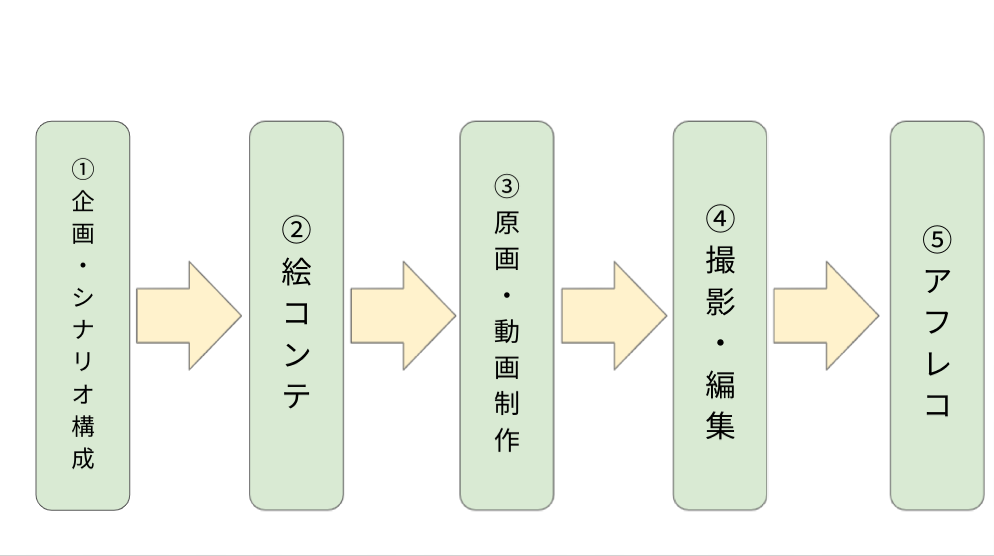
The animation production workflow can be summarized as follows:
The animation production process (Stages)
As we secure production funding, form the team, and refine project proposals internally, we will select a production company if we decide to outsource the work, or handle casting if we choose to produce it in-house.
Introduction to terminology and detailed explanations of the workflow
① Planning and Story Structure
This marks the starting point of animation production. First, a proposal is drafted, and the story structure is developed based on that. By dividing the story into basic scenes following the “exposition, development, turning point, and resolution” structure, and ensuring that the creators share a consistent understanding of the proposal and the script, this process helps production proceed smoothly.
Personally, I view the “beginning, development, turning point, and conclusion” not as a story structure, but as representing the emotional peaks and valleys of a narrative. Story structure refers to the flow of a story—such as showing a climactic scene early on, revealing the protagonist’s personality to elicit empathy, or having the protagonist overcome obstacles with the guidance of a mentor.
While visual expression often takes precedence in Japan, for Hollywood-style systematic screenplay design, it is advisable to reference films and animated works that have garnered widespread empathy.
② Storyboards
These serve as blueprints created in the very early stages of the animation production process. They are produced by outputting concepts as rough sketches or text and documenting them. The primary reason for creating storyboards early on is to concretely visualize the client’s or producer’s ideas for the entire team, thereby guiding the subsequent production.
③ Keyframe and Animation Production
Key animation is broadly divided into “First Key Animation” and “Second Key Animation.” In First Key Animation, the team primarily creates layouts and rough key drawings (rough keys). In Second Key Animation, the team makes corrections to the First Key Animation and refines the character designs.
④ Shooting and Editing
Using materials such as the script, storyboards, and key drawings, the team composites the footage and applies special effects to match the vision of the work.
⑤ Voice Recording
Short for “post-recording,” this refers to the process of recording audio after the animation footage has been completed.
Once production begins, costs accumulate based on the unit price of each task, and the process cannot be reversed. Therefore, if the details of the initial plan are not fully finalized from the start, the animation itself may become unusable.
These production workflows involve significant labor costs. By utilizing “indie animation” created by independent animators, you can save on labor costs and produce animated videos more easily.
Despite growing demand for animation, there is a shortage of planners for business-oriented projects
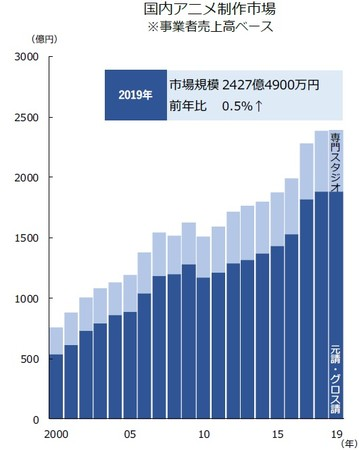
In recent years, an increasing number of corporate executives have been adopting “anime marketing” strategies that leverage animation. According to Teikoku Databank, Ltd.'s “Survey on Trends in the Anime Production Industry,” although the market shrank in 2020 due to the spread of COVID-19, the anime production industry had been experiencing rapid growth up until then.
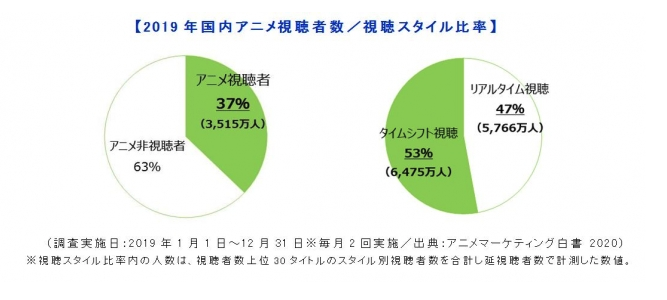
Furthermore, one of the factors driving the growing demand for animation is the fact that it is widely embraced by people of all ages. According to the “2020 Anime Marketing White Paper,” the number of anime viewers in Japan exceeds 35 million, indicating that the medium is enjoyed by a broad range of age groups and a large audience.
Source: Anime Marketing White Paper 2020, “Survey on Consumer Trends in the Entertainment Sector” (KADOKAWA Game Linkage Co., Ltd.)
The animation industry has experienced rapid growth. As you know, some of the key advantages of animation—which is gaining increasing popularity—include the approachability achieved through the use of characters, as well as the ability to clearly convey complex concepts through animation’s diverse expressive techniques, even in scenes where live-action filming would be difficult.
Furthermore, the ability to freely express voices and visuals through the use of characters is likely a key factor in the rising demand for animated video production.
“Anime marketing,” which leverages these strengths of animated videos, is gaining significant attention.
How to write a proposal for animation production
Now, let’s take a closer look at how to write a proposal. When attempting to create a proposal, many people wonder, “What format should I use?” or “Is there a template available somewhere?” However, the writing style and format themselves are not actually the most important factors.
The most crucial thing is to clearly define your company’s products or services and the message you want to convey. A proposal is a document that articulates your vision for the animation project—specifically, “what” you want to produce, “why” you want to produce it, “how” you plan to produce it, and “by when” you intend to complete it.
The key points to consider when creating a proposal are as follows:
Clarify the target audience, objectives, and concept
If the goal is to encourage users to purchase your products, it’s important to communicate their features and specific benefits; if the goal is to raise brand awareness, however, the direction of the animation changes significantly depending on the objective—for example, by emphasizing the product name to leave a lasting impression on users or by creating a video story with a strong visual impact.
Story outline and characters
You’ll need a brief summary outlining the plot, the characters’ appearances and personalities, the challenges they face, and their goals. It’s important to clearly define what you want to convey through your work.
Validate the budget and delivery schedule
An essential part of any proposal is the production timeline and budget. Since the available budget affects the length and quality of the animation, it is important to include this information in the proposal.
Of course, costs will also vary depending on the timeframe over which production is commissioned.
Key points for planning
We’ve explained how to write a proposal up to this point, but it can be difficult to refine the details of a project while juggling other daily tasks. Above all, based on past experience, we know the key elements that minimize the risk of failure—such as incorporating a conflict structure or a guiding character who helps overcome obstacles.
Furthermore, when adapting a brand’s story into an animation, you’ll need marketing expertise and promotional knowledge to make the brand’s customers—your target audience—the protagonists and evoke their empathy. In such cases, we highly recommend consulting with a production company that specializes in promotion right from the planning stage.
At our company, we can certainly support you with planning by listening to your needs, allowing us to produce animated videos that align with your goals. With a network of approximately 2,000 creators, we should be able to easily bring to life the specific style and aesthetic you envision.
Summary of how to properly write an anime proposal
Let’s summarize the key points so far.
・Before writing the proposal, outline the basic elements (what, why, how, and by when)
・The proposal serves as the starting point for the entire animation production process, and its content determines whether the final work will be successful
・It is crucial to understand the importance of basic story structure—including the “exposition, development, turning point, and resolution”—and to establish a shared understanding among the production team
・Storyboards are rough sketches that visualize the concepts developed during the early stages of animation production.
・The purpose of creating storyboards is to concretize the ideas of the client or producer and share them with the entire production team.
・Clarifying the target audience, objectives, and concept is the most critical point in creating a proposal.
・It is important for a proposal to include an overview, character profiles, budget, delivery date, target audience, objectives, and concept.
With these points in mind, when creating an anime proposal, setting clear goals and developing a detailed project plan are the keys to success. Be sure to create a proposal that covers all these essential points.
Start by consulting an animation production company!
We’ve discussed how animation can be a valuable tool for video-based learning materials.
If you’re considering using animation—whether to distribute educational content on YouTube, create training videos for employee on-the-job training or to improve efficiency, or to brand your company’s materials through animation—please feel free to contact us.
At NOKID, we have a large team of illustrators and manga artists, and we handle all voice-over recording in-house, allowing us to deliver high-quality content.
Feel free to contact us!
Tokuma Kanna
Founder and CEO of NOKID Inc., a premier creative studio specializing in short-form animation and graphic design. With a focus on narrative-driven visual storytelling, he has spearheaded high-profile projects across the global entertainment landscape. His portfolio includes the acclaimed VALORANT: YORU TYPICAL DAYS cinematic, the Hatsune Miku x Seven Premium 15th Anniversary campaign, and Koda Kumi’s music video "100 no Kotoba-tachi e." As a leading producer in the PV and MV sectors, Tokuma continues to redefine the intersection of animation and contemporary digital media.