With the rise of platforms like YouTube and TikTok, video and short-form content has become commonplace. While video is an extremely effective tool for corporate branding and product promotion, companies often need to outsource production to external agencies since in-house teams must handle everything from planning to production oversight.
However, the process and costs involved in hiring professionals vary significantly between agencies, leaving many unsure of what to expect.
For instance, how you choose a production company, the necessary costs, and how you communicate your vision—these factors significantly influence the path to a successful promotion. Making the wrong choices risks budget shortfalls, missed deadlines, or unexpected quality issues.
Therefore, this guide explains the process of outsourcing video production and key points for placing orders. Understanding the workflow and preparation steps ensures smoother communication with production companies and minimizes project effort. We encourage you to review this information.
Why is the demand for outsourcing live-action and animated video production increasing?
Video content is utilized across various business scenarios, from presenting the company's overall image to explaining individual products, services, and business models.
In the era when “video advertising = TV commercials,” only large corporations with ample budgets could incorporate video into their marketing.
However, with the emergence of video sites like YouTube, the proliferation of online video advertising accessible even on low budgets, and the development of environments enabling relatively inexpensive video production, a trend has now emerged where not only large corporations but also small and medium-sized enterprises are engaging in video marketing.
The rapid growth of the video advertising market drives increased production demand
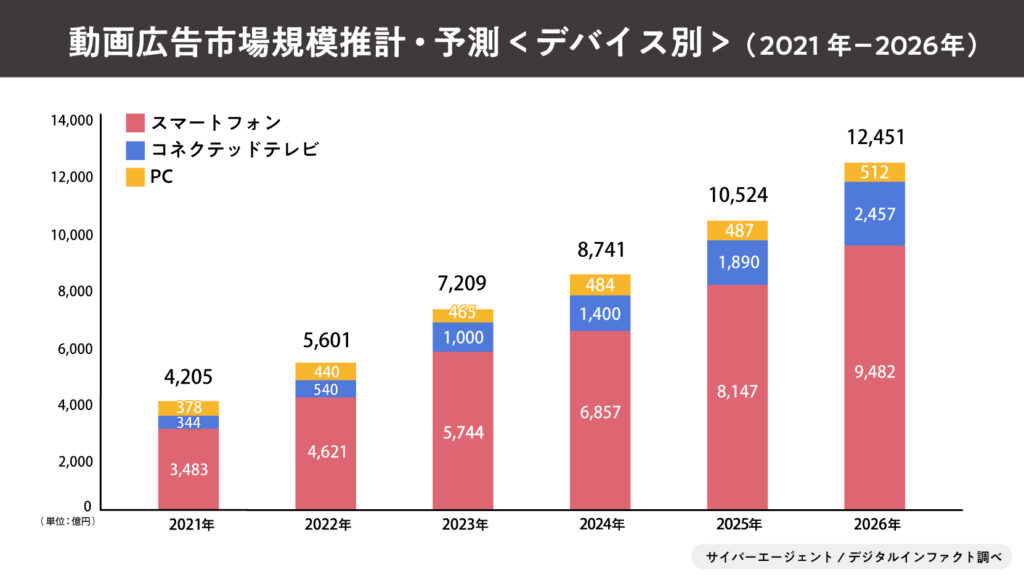
The video advertising market, one of the marketing methods, is experiencing rapid growth year after year.
In fact, according to a joint survey conducted by CyberAgent, Inc. and InFact Inc., the video advertising market is projected to reach ¥720.9 billion in 2023, ¥874.1 billion in 2024, and is estimated to reach ¥1.0526 trillion by 2025.
Video advertising is estimated to account for over 30% of total internet advertising expenditure.
This clearly demonstrates the rapid expansion of the video advertising market.
Which media should be used to distribute outsourced live-action and animated videos?
Opportunities to produce videos for corporate marketing activities have increased, but where can they be used most effectively? Here, we'll introduce the scenarios where your produced videos can be leveraged.
When publishing on self-owned media and channels
One way to utilize videos is to post them on your company website.
For example, on landing pages that serve as destinations for traffic from paid search ads, you need to instantly capture the visitor's interest.
Placing a video in the first view area can grab the visitor's attention, sparking interest and promoting understanding.
Additionally, once you've obtained email addresses from prospects or existing customers, adding videos to email newsletters can be effective. Research shows video emails increase open rates and conversion rates.
To build long-term relationships with existing customers, utilizing a YouTube channel is also recommended.
Getting subscribers provides the benefit of easy access to new content, enabling ongoing communication through regular video uploads.
When publishing via online advertising and marketing
Of course, video content can also be leveraged as advertising.
While YouTube's TrueView once dominated online video advertising, platforms like Facebook, Instagram, and Twitter, along with DSP-based distribution, mobile apps, and outdoor advertising, are now increasingly adopting video ads.
This means that precisely because options have multiplied, selecting the right advertising distribution channels has become a critical factor determining the success of video marketing.
Aim for cost-effective ad management by correctly understanding each medium's key user demographics, targeting capabilities, video ad display methods, billing models, and other characteristics.
The Process of Outsourcing Live-Action/Animation Video Production to a Production Company
From here, we will introduce the general workflow of video production.
The general flow from requesting production to delivery
While the production flow and processes differ between live-action videos and animation, the client's tasks remain fundamentally the same.
Furthermore, since the process from initial consultation to delivery can be broken down into detailed steps, we will introduce each step in greater detail.
Step 1: Communicate details during the production company's initial consultation
First, during the meeting with the production company, clearly communicate “what kind of video you want to create.”
Having a rough outline prepared beforehand—including the “video's purpose,” “target audience,” “message you want to convey,” “approximate budget and deadline,” and “where you want to distribute it”—will help the meeting proceed smoothly and make it easier for the production company to visualize the video's direction.
Step 2: Receive the production company's proposal and estimate
The production company will propose a video concept, structure plan, and estimate based on the meeting content.
It is crucial here to verify that the proposed concept and video structure align with the objectives, target audience, and desired image discussed during the meeting.
Additionally, always confirm whether production is feasible within the budget and desired delivery schedule before formally placing the order.
Step 3: Design the content based on the proposal
Once the contract and order are finalized, we proceed to refine the details of the proposal submitted by the production company.
This is the stage where the production company develops the structure and script.
The video content is created as rough sketches or storyboards. Review these and communicate any requests you may have.
Some companies may create video storyboards based on the rough drafts, making it easier to visualize the final look.
Significantly changing the content after filming begins can disrupt scheduling. Therefore, it's crucial to thoroughly align your vision and finalize the details at this stage until you are fully satisfied.
Step 4: Proceed with shooting/producing
Once the video design is finalized and the content is confirmed, actual filming begins—or production commences for animation projects.
The production company handles various preparations beforehand, such as arranging the shooting location, conducting location scouting, securing personnel like cast and cameramen, preparing equipment, and creating the shooting schedule. Filming then takes place on the scheduled day.
The client may also be present during filming. In such cases, filming proceeds while reviewing the actual footage together.
If you are present during filming, be sure to carefully observe the filming process to confirm there are no differences in understanding.
Step 5: Combine all materials, edit appropriately, and deliver the final product
Once filming is complete, the production company begins the editing process, reviewing the footage and connecting the necessary scenes.
They don't simply string scenes together to match the story; they also edit with clarity and visual design in mind.
Beyond video editing, this stage also involves adding background music, narration, captions, illustrations, CG elements, and other such work.
However, the level of refinement at the first draft stage is determined through discussion with the client, so be sure to communicate your requests beforehand.
The finished product after editing is submitted as the first draft. Review it thoroughly and request any necessary revisions. Once revisions are complete, the footage is delivered.
What is the typical cost range for outsourcing live-action/animation video production to a company?
Video production costs can be broken down into three main categories
Video production costs can be broadly categorized into three main areas: “planning fees,” “shooting/illustration production fees,” and “editing fees.” The overall cost scale is determined by how much manpower, time, and expenses each of these requires.
For example, even a 15-second short video can cost several million yen if it involves using multiple cast members in a studio, renting specialized camera equipment, or performing visual compositing work.
Creating 3D CG visuals also requires specialized skills and a considerable amount of time.
To reduce video costs, gather some materials in-house
However, conversely, by providing in-house resources such as video and image assets, filming locations, and cast members, it is possible to keep production company estimates low even for longer videos.
Experienced production companies possess various cost-saving techniques, so there's no need to give up on video production just because your budget is tight. If you convey your vision of “the kind of video you want to create,” they will likely propose various solutions. Therefore, it's important to start by consulting with them.
Points to note when outsourcing live-action/animation video production to a company
When outsourcing, thorough preparation is paramount. To put it bluntly, the success of a production hinges entirely on how well you prepare beforehand—it drastically alters the outcome.
By clearly defining the following points with your team and relevant departments at a high level of detail before selecting a video production company, you can significantly increase your chances of avoiding video production failures.
Clearly communicate the overall direction and avoid handing over everything completely
To smoothly produce a good video, it is essential to thoroughly solidify and clarify necessary information such as the purpose and target audience internally at the request stage, ensuring it can be communicated to the production company.
Furthermore, it is crucial to conduct checks at each stage and consistently share the vision with the production company.
If requests like “Actually, we'd like to change that part” arise after the process has progressed, it becomes time-consuming and can lead to delayed delivery dates or additional costs, so caution is necessary.
Early communication and alignment are crucial
To achieve this, we will thoroughly review each request for verification as it arises. If changes are requested later with statements like “Actually, I'd like it done this way,” it leads to rework and causes schedule delays. Therefore, we will review each request promptly and request any necessary corrections on the spot.
When questions arise, it is also crucial not to leave them unresolved but to confirm and resolve them properly at that very moment.
How to choose a production company or freelancer for outsourcing live-action/animated video
I've explained the production process, but as the person in charge, you're probably wondering, “Where should I place the order?”
From here, I'll introduce three particularly important points for selecting an outsourcing partner.
Check if they have experience with the same purpose and production techniques
Frankly, experience within the same industry isn't always essential. I find it more effective to look at a production company's track record in terms of “production techniques” and “video applications”—such as documentary-style storytelling or character animation.
This is because extensive experience within the same industry often leads to similar patterns to competitors. To make a lasting impression on viewers, experience across different industries proves more valuable.
It's wise to confirm what production techniques and video applications a candidate production company excels at, and then select one whose strengths align with the type of video your company requires.
Check if revisions are possible and how many times
As production progresses, revisions are almost always required.
There are numerous areas that may need adjustments, such as the size, position, and timing of captions, or changes to background music.
Therefore, the question “How many revisions are included at no extra cost?” becomes a crucial point.
A common pitfall is hiring a low-cost or bargain production company only to discover that “revision fees are charged separately.”
Ultimately, requesting multiple revisions not only takes time but can also result in unexpectedly high revision fees, potentially exceeding the production budget. Therefore, always confirm the number of free revisions before placing an order.
Check if they have knowledge and experience beyond production
Most production companies can likely create videos that closely match the client's vision if the budget allows.
However, what truly matters in production is whether the client's objectives can be achieved.
Creating beautiful visuals or entertaining videos is not the goal.
Therefore, when selecting a production company, it's crucial to thoroughly check whether they possess a deep understanding of marketing.
During the initial meeting, instead of just saying “I want to make this kind of video,” clearly communicate your objective: “What do you want to achieve with the video?” Choose a production company that can provide precise answers aligned with that objective.
A video production company with deep understanding of video marketing should always be able to provide clear, logical answers that work backward from the goal.
Summary of the process for outsourcing live-action/animated video
We've introduced the video production process and key points for commissioning projects. How did you find it?
While there are several points to consider during production, clarifying the client's intent and purpose—namely, “Why are we creating this video?”—remains the most crucial step.
Moving forward, video-based marketing techniques will likely become even more standard.
Use this article as a reference to grasp the video production process, and we encourage you to consider video production as part of your marketing strategy.
Marketing Perspective in Japan: Beyond Just Creation
NOKID provides creative planning and production for PR using characters, events, and video content. Effective videos balance business and creative perspectives, e.g., short clips optimized for TikTok, designed to capture attention in the first 2–3 seconds.
For first-time animation or PR-focused content, feel free to consult with us.
Tokuma Kanna
Founder and CEO of NOKID Inc., a premier creative studio specializing in short-form animation and graphic design. With a focus on narrative-driven visual storytelling, he has spearheaded high-profile projects across the global entertainment landscape. His portfolio includes the acclaimed VALORANT: YORU TYPICAL DAYS cinematic, the Hatsune Miku x Seven Premium 15th Anniversary campaign, and Koda Kumi’s music video "100 no Kotoba-tachi e." As a leading producer in the PV and MV sectors, Tokuma continues to redefine the intersection of animation and contemporary digital media.